Certifications and Forms to Provide After IT E-Waste Recycling
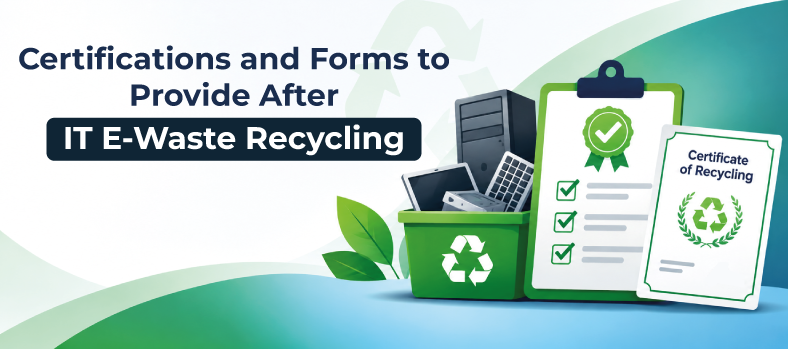
When a company disposes of old laptops, desktops, servers, printers, and other IT assets, documentation is an important part of the recycling process. Documentation demonstrates that your assets have been managed responsibly, sensitive data has been protected, and environmental and tax regulations are met.
Why Documentation Matters After E-Waste Recycling
Proper documentation provides evidence that you are recycling your e-waste responsibly. It keeps you in line with regulations, makes everything transparent, and ensures a reliable record of asset disposal.
Benefits for Corporate Clients
Documentation such as certificates for recycling and data destruction, and asset-level documentation will provide your business with proof that your IT assets have been managed properly. This will help during audits, information security reviews, ESG reporting, and vendor management. It will also help avoid any confusion with regard to your assets.
Benefits for ITAD and Recycling Companies
Accurate documentation shows that ITAD and recycling companies are taking responsibility for their assets. This helps with tracking the assets they receive and how many have been processed, any regulatory reporting, and providing proof if required by their customer, auditor, or regulatory body.
Certificate of Recycling: This certificate verifies that the e-waste received has been recycled through the given recycling route. This should include information on the customer, recycling partner, date of processing, type(s) of equipment, quantities/weights, and facility information.
Asset Disposal or Destruction Certificate: This certificate shows how the retired assets were disposed of. This can be through recycling, physical destruction, or other approved methods. It includes details of the asset, including serial numbers if available. The date of disposal and method should also be included.
Certificate of Data Destruction: This certificate will provide proof that the data has been sanitised/destroyed as per the selected data sanitization methods. It demonstrates secure data handling and destruction of confidential business data, ensuring data protection regulations are met.
EPR Certificate: EPR certificates are specific certificates under the E-Waste (Management) Rules, 2022 in India. They are issued by registered recyclers through the Central Pollution Control Board (CPCB) portal. This will allow producers to meet their EPR requirements.
Forms and Documents to Provide
GST Invoice:
- If applicable, the GST invoice will provide proof of the transaction. This should include invoice details, GSTINs, service/goods description, taxable amount, applicable tax & other relevant details.
- This helps with reconciliation; however, it will not provide proof that the assets have been recycled or data destroyed.
Form 6 – E-Waste Manifest:
- This will provide proof of the movement of waste from the sender to the transporter and facility. This was required under the previous E-Waste (Management) Rules, 2016.
- If applicable, keep a copy of the manifest or equivalent. It includes waste details, quantities, sender details, receiver details, transporter details & dates.
Serialised Asset Inventory or Disposal Report:
- This is one of the most useful documents to provide to your corporate IT team. This will show what assets have been handed over and what has been processed, returned, refurbished, or destroyed.
- A good report includes asset information, quantities, processing status, destruction of data, and discrepancies.
Battery Waste Documentation — Form 10
- IT assets can contain lithium-ion, lead-acid, or other batteries. These should be handled correctly. Battery waste should be managed under the relevant Battery Waste Management Rules, 2022.
Form 6 vs Form 10: Key Differences
| Basis | Form 6 | Form 10 |
|---|---|---|
| Regulatory Framework | Earlier E-Waste Rules, 2016 | Hazardous & Other Wastes Rules, 2016 |
| Purpose | Manifest for e-waste movement | Manifest for applicable hazardous waste movement |
| Typical Information | Sender, transporter, receiver, and e-waste quantity | Sender, transporter, receiver, hazardous waste details, and acknowledgements |
| Current Relevance | Verify requirements under the 2022 E-Waste Rules | Applies where the relevant hazardous-waste provisions require it |
Best Practice for ITAD and E-Waste Recyclers
Maintain Serial-Level Records
Keep track of the serial numbers of the assets received and ensure they match up to the final processing. If any are missing, illegible, or do not match, highlight these. This will make auditing and verification by your customer easier.
Authorised Recycling Partners
Ensure that your downstream recyclers have the correct registrations and authorisations in place. Keep copies of any relevant documentation and ensure you have a record of the assets being passed to downstream facilities.
Retain Compliance Records
Keep track of the serial numbers of the assets received and ensure they match up to the final processing. If any are missing, illegible, or do not match, highlight these. This will make auditing and verification by your customer easier.